📸 INSERT HERO IMAGE HERE
Upload a casual personal photo of Emeka (the blog persona).
Ideal: a man in relaxed clothing, looking thoughtful. Size: 700 x 400px.
You've tried to stop.
Not once. Not twice. You have tried more times than you are willing to admit out loud.
You deleted the app on a Tuesday and downloaded it again by Friday. You made a fresh promise to yourself after prayers on Sunday and broke it before the week ended. You set a new start date — Monday morning, first of next month, after this project, after this exam — and none of those start dates survived contact with a restless night and a phone within reach.
What is wrong with me?
That question. You have asked it in the dark, lying on your bed at 2am, staring at nothing. You have asked it silently at the back of church while the pastor preaches about self-control. You have asked it in the shower, on your work commute, in the middle of conversations you are supposed to be present for but aren't.
And then there is the other problem.
The one you speak about with nobody. The one that lives in your chest like a stone.
With a real woman — someone you care about, someone whose opinion of you matters deeply — your body doesn't cooperate the way it should. You finish too fast. Or you can't stay present. Or you get there and then lose it halfway. And the cruelest part of all this is that alone, without pressure, everything works perfectly. Every single time.
So why? Why does your body fail you at the exact moment it matters most?
You have told yourself it's stress from work. You have blamed the girl, the timing, the food, the heat. You have Googled symptoms at midnight and closed seventeen tabs without finding a single answer that felt true. You have prayed about it. You have fasted. You have made promises to God and yourself that you have broken repeatedly — and each time you break them, the shame goes a little deeper and the silence gets a little thicker.
Because this is not something you can tell your friends. You can't call your brother. You certainly cannot raise this with your pastor. Nigerian men handle these things alone and in silence — and that silence, more than anything else, is what has kept you locked in this cycle month after month, year after year.
If what you just read landed like a punch to the chest — like someone finally described the inside of a room you have been alone in for a very long time...
Drop everything you are doing right now. And read every word I am about to say.
Our grandfathers didn't have this problem.
Think about that for a moment. The men who came before us — the men who built this country, raised large families, carried themselves with a quiet, unshakeable authority — they did not have smartphones. They did not have the internet. They did not have access to the kind of content that is now available in four clicks and three seconds. And they moved through the world differently. They understood their bodies. They understood the connection between the mind and the body in a way that modernity has almost completely erased from our generation's awareness.
That knowledge did not disappear. It just went quiet. It got passed down in whispers — from grandfather to son, from village elders to young men at the right moment, at a family gathering, under a tree, when a boy became a man and needed to understand what that actually meant. And one Easter weekend in Anambra, almost by accident, that knowledge found its way to me.
My name is Emeka Nwosu.
The first thing you should know about me: I am not a doctor. I am not a therapist. I am not any kind of certified expert. I am a 29-year-old man from Enugu who works in Lagos — just like thousands of men reading this right now — who fought this battle silently for four years and finally found the way out of it. Not through a clinic. Not through Google. Through a 71-year-old man sitting under a mango tree who saw something in my face that I had told nobody about — and spoke the words that changed everything.
📸 INSERT PERSONA PHOTO HERE
A candid, personal-looking photo of Emeka (blog persona).
Perhaps at a desk, or relaxed at home. Ideal size: 400 x 500px.
My Story. And Very Possibly, Yours.
I was in my second year at university when it started.
It was not a big deal at the time. It was just something you did when the nights were long and the generator had gone off and there was nothing else to do. Every man around me was doing the same thing. Nobody talked about it. Everybody knew. It was just part of campus life — harmless, temporary, something you would naturally grow out of once real life began.
I was wrong about that last part.
By my third year, I needed it to wind down at night. By my final year, I needed it just to feel normal before I could face the day. I graduated, moved to Lagos for my first job at a logistics company in Victoria Island, and the habit came with me — packed quietly in my laptop bag alongside my NYSC certificate and my clean work shirts. I told myself it was just a stress relief mechanism. Something I fully controlled.
I believed that for longer than I should have.
I met Adaeze in 2021. She was warm and intelligent and had a specific kind of patience about her — the kind that is quiet and steady rather than loudly announced. We dated for seven months before we became intimate. And that first night, I knew immediately that something was deeply, fundamentally wrong.
It ended in under two minutes.
She didn't say anything. She placed her hand on my chest. "These things happen," she said softly. "Don't worry about it."
But I worried. I worried every night for the next three months.
Because it happened again the next time. And again after that. And then something new started — I couldn't stay present. My mind would drift mid-moment, like a television losing signal. My body was there but I had left the room somehow. And alone — completely alone — everything worked normally. Every time. Without fail.
That specific contrast was the most confusing and humiliating thing I have ever experienced.
I started creating distance. I started coming home from work later than necessary. I started small arguments before bedtime so that intimacy would be the last thing on either of our minds. I began sleeping at the furthest edge of the bed — as far from her as the mattress allowed — dreading the moment she would reach for me in the dark.
She noticed. Of course she did. Good women always notice the things you are trying hardest to hide.
About eleven months into our relationship, she sat across from me at the kitchen table one afternoon. She didn't look angry. She looked sad in a way that was much worse than anger — quietly, privately sad. And she said:
"Emeka. Are you still attracted to me?"
That question broke something open in my chest.
Not because I didn't know the answer. But because the real answer — the true, complicated, shameful answer — was one I could not begin to explain to her. Or to anyone.
That same month, my godmother came to visit Lagos from Nnewi. She was old school in the way that certain women of that generation are — sharp, direct, carrying a kind of wisdom that has nothing to do with formal education and everything to do with having lived long and watched people carefully. She sat with me one evening on the balcony and looked at me the way those women look at you — like they can see straight through your chest to whatever is sitting in there, heavy and unspoken.
She said: "Emeka. Something is wrong with your energy. A man who cannot be present with his woman has already left her — even if his body is still in the room. Find the root of the problem. Not the branches."
Find the root.
I spent the next fourteen months looking for the root. And I tried everything.
I tried cold showers every morning — the ones they recommend endlessly on YouTube and Reddit. Five minutes of freezing water at 5am. I did it for two solid weeks, shivering in my bathroom before dawn. It built discipline. It did absolutely nothing for the actual problem.
I tried pharmacy supplements. A man at my office — I will not say who — told me quietly about a product he bought somewhere in Obalende. I spent ₦8,500 on tablets that gave me persistent headaches and produced no other result whatsoever. They are still in a drawer somewhere.
I tried fasting and prayer. I am a Christian man, and I am not ashamed to say that I genuinely believed for a period that what I was experiencing was a spiritual attack. I fasted for three days. I went for a special prayers session at a ministry in Surulere that a close friend swore by. I held onto that experience for six days — and then relapsed anyway on a Wednesday night after a bad day at work. The shame that followed that particular relapse was unlike anything I had felt before.
I tried accountability apps and phone blockers — I installed three different content-blocking applications on my phone, deleted every relevant app, and gave a trusted friend access to my screen time reports. It lasted nine days before I found a workaround at 1am that I am still slightly embarrassed to describe.
I tried exercise. Running five kilometres every morning, believing that physical exhaustion would quiet the urges by evening. It improved my cardiovascular fitness considerably. The urges remained exactly where they were.
I tried an online recovery program I found on a forum at 2am. ₦22,000. It arrived as a PDF assembled from articles I could have found for free on Google, written by someone who had clearly never spent a single day understanding what it means to fight this specific battle inside this specific culture, in this specific silence. It went unfinished after Day 4.
None of it worked.
Because none of it was addressing the actual root.
It was Easter weekend, 2023.
We had travelled to our family compound in Anambra — the kind of gathering that fills every room and spills into the yard and carries the specific noise and warmth that only a large Nigerian family can produce. Children everywhere. Aunties cooking in rotating shifts. The sound of a generator and distant music and a dozen conversations happening simultaneously.
I had stepped away from it all and gone to sit under the old mango tree at the back of the compound. My mind was somewhere dark. Adaeze and I had barely spoken in three weeks. I was running out of distance to create and out of excuses to offer.
An old man walked from the main house and sat in the empty plastic chair beside me.
Pa Okonkwo. Seventy-one years old, though he carried his age lightly — sharp eyes, slow movements, the particular stillness of a man who had nothing left to prove. He had spent over forty years as a traditional wellness practitioner in the Anambra region — not a herbalist in the commercial sense, but the kind of figure communities quietly brought their most difficult, most private problems to when modern medicine and prayer had both been tried and had not reached the root. He was my father's uncle. I had met him perhaps four times as a child and had not seen him in over fifteen years.
He sat beside me without saying anything for a long time. Just watching the children play from a distance.
Then he spoke, without turning to look at me.
"You have the look of a man at war with his own body."
I turned to stare at him. He still wasn't looking at me.
"The things your generation is fighting," he continued, his voice low and even, "they are not what you think they are. You think it is a weakness of character. A spiritual failure. A private flaw that marks you as less of a man. But your grandfather's generation had a different understanding of this. When a man's fire is not responding the way it should respond — not with a real woman, not in the moments that count — it means the messengers in his brain have been confused. Not broken. Confused. And confused things can be unconfused, given the right protocol and enough patience."
I did not move. I did not breathe normally.
He finally looked at me. And I had the strangest sensation — the way you feel when someone describes a room you thought only you had ever been inside of.
"The cold baths won't fix it," he said. "The pharmacy products won't fix it. Prayer will support your spirit, but prayer alone will not rewire your brain — that requires a different kind of work. What you need is a precise protocol, done in a specific sequence, over a specific number of days. Your grandfather's generation understood this. They called it by different names in different villages. Today, the scientists at their universities call it dopamine recalibration, neuroplasticity, reward system restoration. The names are new. The principle is as old as the men who built our culture."
He spent the next hour explaining.
He explained how years of high-stimulation content physically rewires the brain's reward system — not as punishment, not as a spiritual consequence, but as a documented, measurable biological process. Every time you seek that specific stimulation, your brain releases dopamine. Over months and years, the brain begins to need increasingly intense stimulation to produce the same release. Real intimacy — which is softer, slower, more complex emotionally — begins to register as insufficient by comparison. And then your body stops responding to it the way it should.
He explained the Shame-Relapse Loop — the psychological cycle that makes every recovery attempt collapse. You fail. You feel deep shame. That shame becomes its own trigger — driving you back to the same escape mechanism you were trying to leave. Which produces more shame. Which produces another relapse. You have not been weak. You have been caught in a documented neurological pattern with a specific, reversible mechanism.
He explained the three tracks that must run simultaneously for 21 days. The brain reset protocol — daily urge interruption techniques and environmental redesign. The natural vitality stack — Nigerian foods and herbs that have supported male hormonal health and dopamine balance for generations, eaten and prepared the right way. And the psychological reconditioning — specific techniques to rebuild the mental and emotional presence that this kind of damage takes away.
I listened to everything he said.
And then I said what I imagine you might be thinking right now.
"Pa, with the greatest respect — this sounds too simple. I have tried programs. I have spent money. I have fasted. And you are telling me the answer is tiger nuts and breathing?"
He smiled. Not an offended smile. A patient, knowing one.
"The most powerful things always appear simple from the outside," he said. "That is exactly why your generation keeps searching for something complicated and expensive — and walks past the thing that actually works."
I returned to Lagos on Easter Monday and began the protocol that same night.
The first four days, I felt almost nothing different. The urges came at their usual hours, in their usual strength. My brain was restless at night in its familiar way. By Day 4, I was genuinely ready to conclude that I had been given the polite version of nothing.
And then Day 6 arrived.
I woke up that morning and noticed — quietly, without drama — that I had slept through the entire night without a single urge. I lay in bed for several minutes, just waiting for it to arrive. It didn't come. The morning felt clean in a way I had not experienced in years — not effortful, not suppressed. Simply absent.
That sounds like a small thing. It was the most significant morning I had experienced in four years.
By Day 10, the urges that did arrive were weaker. They came and went like a wave that reached the shore and receded instead of crashing. I used the 3-Second Override Method Pa had taught me each time they arrived, and each time it worked in a way that no affirmation or accountability partner had ever worked before.
By Day 14, something deeper was shifting.
I was becoming present again. Not just physically. Mentally, emotionally present. I could sit with Adaeze in the evenings and actually be there — actually hear what she was saying, actually feel her warmth beside me — without my mind pulling away into that flat, distant place it had been retreating to for years.
She noticed before I said a single word about it.
We were on the couch on a Thursday evening, watching a film, and she turned to me mid-scene and said quietly: "Emeka. You're back. Where have you been?"
She took my hand. Neither of us said anything else for a while.
But I felt the entire weight of two years shift off my chest in that one moment.
By Day 21, I was a different man. Not dramatically, not in a way that required announcement. Quietly. The way real change actually happens — not like a lightning bolt, but like the sun rising slowly until you realise, without being able to pinpoint the moment it happened, that everything is light.
Three months later, a cousin who had also been at that gathering — he had spoken with Pa Okonkwo separately that same evening — called me.
"Brother," he said, without any preamble. "That old man changed my life."
Over the months that followed, two other men from that gathering found ways to reach out to me. One was 34, married, who had been convincing himself for years that his performance issues were simply stress from a demanding job. Another was 26, recently engaged, quietly terrified about what marriage would expose about him. Both of them followed the protocol exactly. Both reported the same turning point — somewhere between Day 6 and Day 10, something shifted. The brain began to remember how to be calm. The body began to reconnect to what was real and present in front of it.
That was when I understood that what Pa Okonkwo had given me needed to reach more people than I could call individually.
By the time the fifth person messaged me asking to walk them through the protocol, my WhatsApp inbox had become impossible to manage. Voice notes. Questions at midnight. Men from Lagos, Abuja, Enugu, Port Harcourt — and then men in London, Houston, Toronto who had found me through someone who knew someone.
I couldn't keep doing it one conversation at a time.
So I spent months doing it properly. I documented everything Pa Okonkwo shared with me in that hour under the mango tree, and everything I learned through my own 21 days. I cross-referenced the protocol against published research on neuroplasticity and dopamine system recovery. I had the entire system professionally structured, written, and designed into a clear, day-by-day guide that any Nigerian man can follow from his phone — without visiting a pharmacy, without a prescription, without disclosure to anyone, and without spending thousands on things that don't address the actual root.
I put everything inside one complete guide.
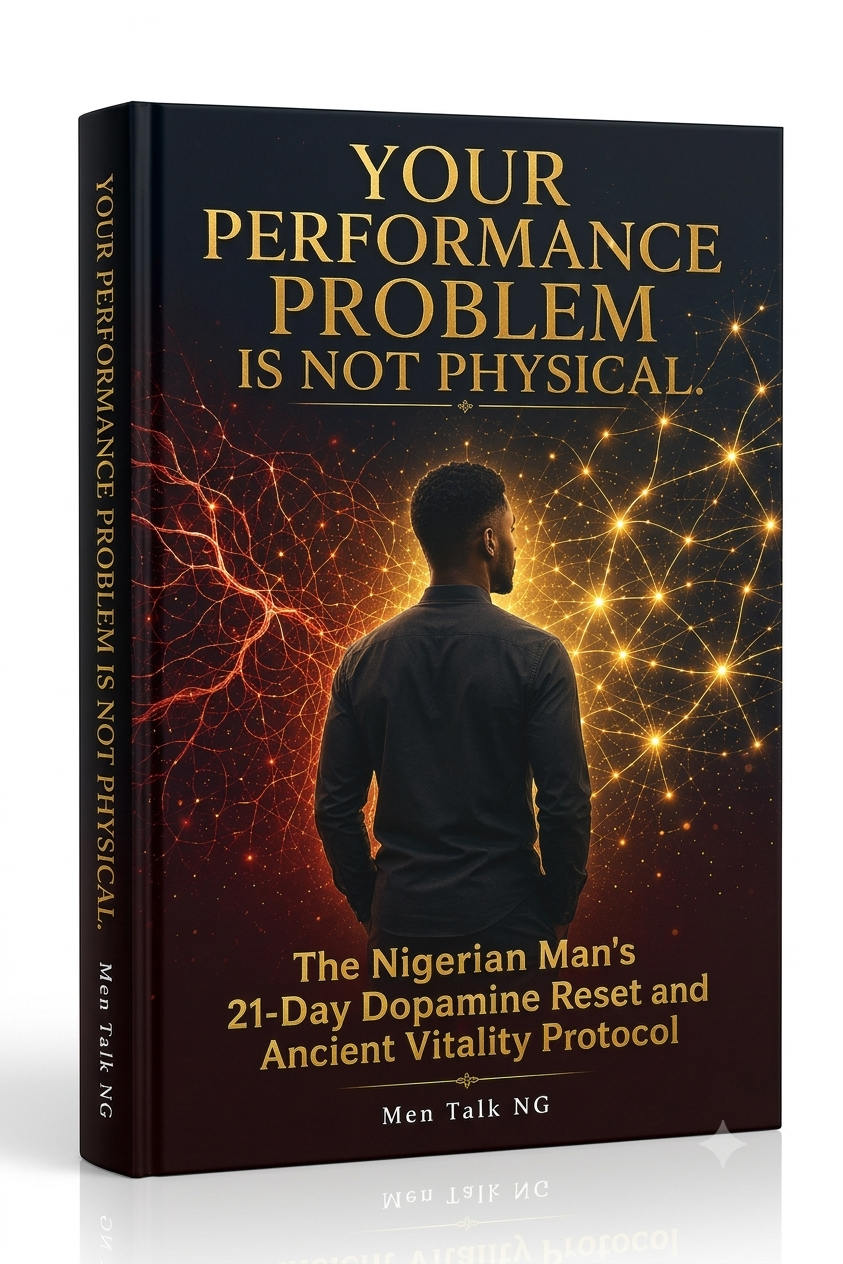
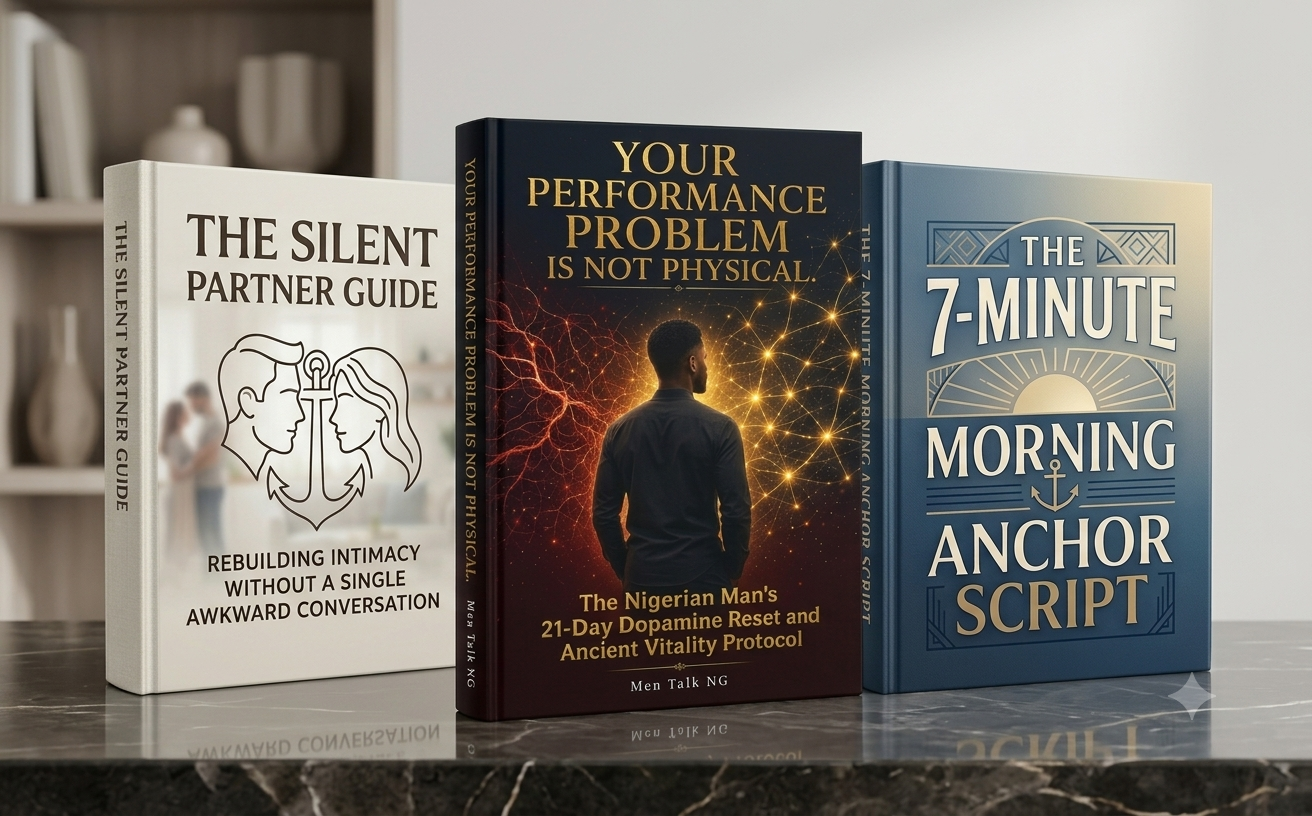
The full 21-day protocol. The natural vitality foods and herbs with precise market names, sourcing guidance, and preparation instructions. The daily brain reset techniques. The psychological reconditioning system for performance anxiety. The emergency urge tools. The relationship restoration guidance. All of it. In one place. For the first time.
Introducing...
Share Your Own Experience